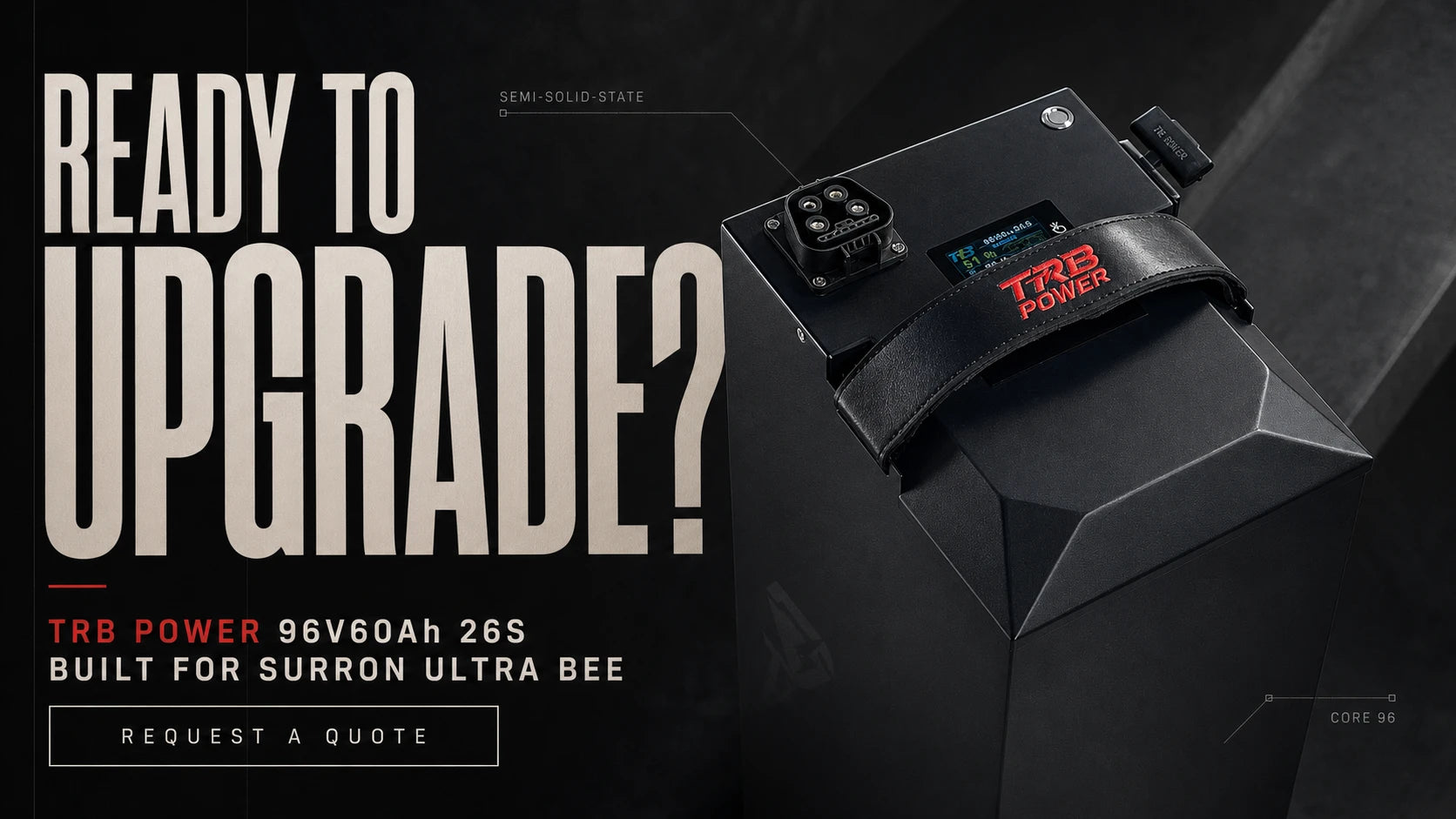
A technical look at the 26S high-voltage architecture, 60Ah capacity, 5.76kWh nominal energy platform, and the system requirements behind a serious Ultra Bee battery upgrade.
TRB POWER has officially released its new 96V60Ah 26S semi-solid-state battery for the Surron Ultra Bee.
The headline specifications are clear: a 96V platform, 60Ah capacity, 26-series architecture, and 5.76kWh of nominal energy. But the real value of this battery is not found in one number alone. It comes from how voltage, capacity, battery architecture, controller compatibility, motor demand, wiring, connectors, charging, and thermal management work together as a complete power system.
This article explains what the confirmed specifications mean, why 26S matters, and what riders and performance builders should check before planning a 96V Ultra Bee build.
Confirmed Product Information
| Item | Product information |
|---|---|
| Product | TRB POWER Ultra Bee upgrade battery |
| Vehicle platform | Surron Ultra Bee |
| Voltage platform | 96V |
| Capacity | 60Ah |
| Series configuration | 26S |
| Nominal energy | 5.76kWh |
| Technology | Semi-Solid-State |
| Positioning | High-voltage, high-energy performance upgrade platform |
| Release status | Officially released |
Specifications such as discharge-current limits, maximum charge voltage, charger configuration, physical fitment details, connectors, and delivery availability should be confirmed with TRB POWER for the rider's exact build before ordering.
What Does 26S Mean?
The term 26S describes the battery's series architecture. It means that 26 cell groups are connected in series to establish the pack's voltage platform.
Series configuration is important because voltage is created by adding the voltage of each cell group across the pack. TRB POWER designates this product as a 96V platform, while 26S identifies the underlying series structure used to build that platform.
However, 26S does not tell the entire story by itself. It does not independently define:
- The pack's permitted continuous or peak discharge current
- The exact maximum charged voltage
- The controller's compatible voltage range
- The charger specification
- The battery's thermal limits
- Connector and cable requirements
- Physical fitment for every modified Ultra Bee
Those values depend on the complete cell system, BMS configuration, pack engineering, charger, and vehicle setup. This is why a 26S battery must be treated as part of a complete high-voltage system rather than as a simple plug-in number upgrade.
Why a 96V Platform Matters
For an electric motorcycle power system, the basic relationship is:
Power = Voltage x Current
At the same electrical power level, a higher system voltage can reduce the current required to deliver that power. In a properly matched system, this can reduce some of the current burden placed on cables, connectors, the controller, and the battery compared with trying to reach the same power through current alone.
This does not mean that a 96V battery automatically makes an Ultra Bee faster. Final performance still depends on:
- Controller voltage and current limits
- Motor design and operating speed
- Battery discharge capability
- BMS calibration
- Gearing and wheel setup
- Vehicle mass and rider weight
- Terrain, temperature, and traction
- Software tuning and thermal management
The main advantage of 96V is system headroom. It creates a stronger electrical foundation for compatible high-power motors and controllers, especially in builds designed for repeated acceleration, long climbs, sand, aggressive off-road riding, or sustained high load.
For a broader explanation of this principle, read Why 96V Changes the Ultra Bee Riding Experience.
What 60Ah and 5.76kWh Tell Us
Voltage explains the electrical platform. Amp-hours describe capacity at that voltage. Watt-hours provide the clearest high-level view of stored energy.
Using the product's stated 96V and 60Ah ratings:
96V x 60Ah = 5,760Wh, or 5.76kWh of nominal energy
This energy platform is intended to support riders who need more than a short burst of peak output. It gives high-power Ultra Bee builds a larger energy reserve for demanding riding and longer sessions.
Real riding range cannot be predicted from 5.76kWh alone. Energy consumption changes with speed, acceleration, elevation, surface conditions, tire pressure, temperature, rider weight, motor efficiency, controller tuning, and riding style. A hard off-road session in deep sand or on repeated climbs can consume energy very differently from steady riding on level ground.
For that reason, 5.76kWh should be understood as a nominal energy specification, not as a guaranteed distance claim.
Why Semi-Solid-State Technology Is Important
The new battery uses a semi-solid-state technology route. This makes the release more than a voltage and capacity update; it also represents a new battery-technology direction for TRB POWER's high-performance electric motorcycle platform.
Semi-solid-state battery systems use an electrolyte architecture that differs from conventional liquid-electrolyte lithium-ion designs. The term describes a technology category, but it should not be used by itself to promise a specific service life, safety result, energy density, discharge rate, or riding range.
Those product-level outcomes must come from the actual cell selection, pack construction, BMS strategy, thermal design, validation process, and operating limits of the finished battery.
For riders, the practical point is simple: the technology route matters, but the quality of the complete engineered battery system matters more than the label alone.
A 96V Battery Requires Complete System Matching
A high-voltage battery upgrade should never be evaluated in isolation. Before installing the TRB POWER 96V60Ah 26S battery, the complete Ultra Bee build must be checked for compatibility.
1. Controller
The controller must support the battery's actual operating-voltage range, including its maximum fully charged voltage. Current limits, protection settings, regenerative-braking behavior, and communication requirements must also be reviewed.
2. Motor
The motor must be suitable for the controller's intended voltage, speed, torque, and thermal load. A higher-voltage battery cannot compensate for a motor that is outside its safe operating range.
3. BMS and System Protection
The BMS must manage the 26S architecture and the product's defined operating limits. Fusing, contactors, pre-charge behavior, shutdown protection, and fault handling are part of the complete safety system.
4. Wiring and Connectors
Main cables, phase wires, terminals, and connectors must be rated for the actual voltage and current of the build. Connection quality, insulation, abrasion protection, and routing are essential in a high-power off-road motorcycle.
5. Charger
Only a charger approved for the exact battery configuration should be used. A charger should never be selected from the marketing voltage name alone.
6. Physical Fitment
Battery dimensions, mounting, enclosure clearance, cable routing, connector access, and retention must be confirmed for the specific Ultra Bee and its modifications.
7. Tuning and First Commissioning
Controller limits and riding maps should be configured for the complete system. Initial testing should be controlled, with connector temperature, cable routing, fault behavior, and pack performance checked before aggressive riding.
Who Is This Battery Built For?
The TRB POWER 96V60Ah 26S semi-solid-state battery is positioned for:
- Surron Ultra Bee riders planning a serious high-voltage build
- Riders upgrading to a compatible high-power motor and controller
- Off-road users who place sustained load on the power system
- Performance workshops building complete Ultra Bee upgrade packages
- Dealers seeking a flagship high-voltage battery solution
- Electric motorcycle teams that need battery, controller, and motor matching support
This is not simply a larger replacement battery. It is a platform component for riders and builders who understand that high performance depends on the complete electrical system.
Information to Prepare Before Contacting TRB POWER
To receive a more accurate compatibility and ordering recommendation, provide:
- Your Surron Ultra Bee model and model year
- Your current controller model and voltage limit
- Your motor model
- Existing connector and wiring configuration
- Primary riding use, such as trail, sand, climbing, racing, or long-distance off-road riding
- Target performance level
- Delivery country or region
TRB POWER can then review the project requirements and provide the appropriate product, compatibility, pricing, and first-batch delivery information.
The New 96V Ultra Bee Platform Is Here
The official release of the TRB POWER 96V60Ah 26S semi-solid-state battery marks an important step for high-performance Surron Ultra Bee development.
Its significance is not limited to a larger voltage or capacity number. The 26S architecture establishes the high-voltage platform, 60Ah provides a substantial energy reserve, 5.76kWh describes the nominal stored energy, and the semi-solid-state route introduces a new technical direction for the product line.
Most importantly, it gives serious riders, workshops, and performance builders a new foundation for developing a properly matched 96V Ultra Bee power system.